Article: Custom Fragrance Development for Global Brands | From Concept to Finished Fragrance
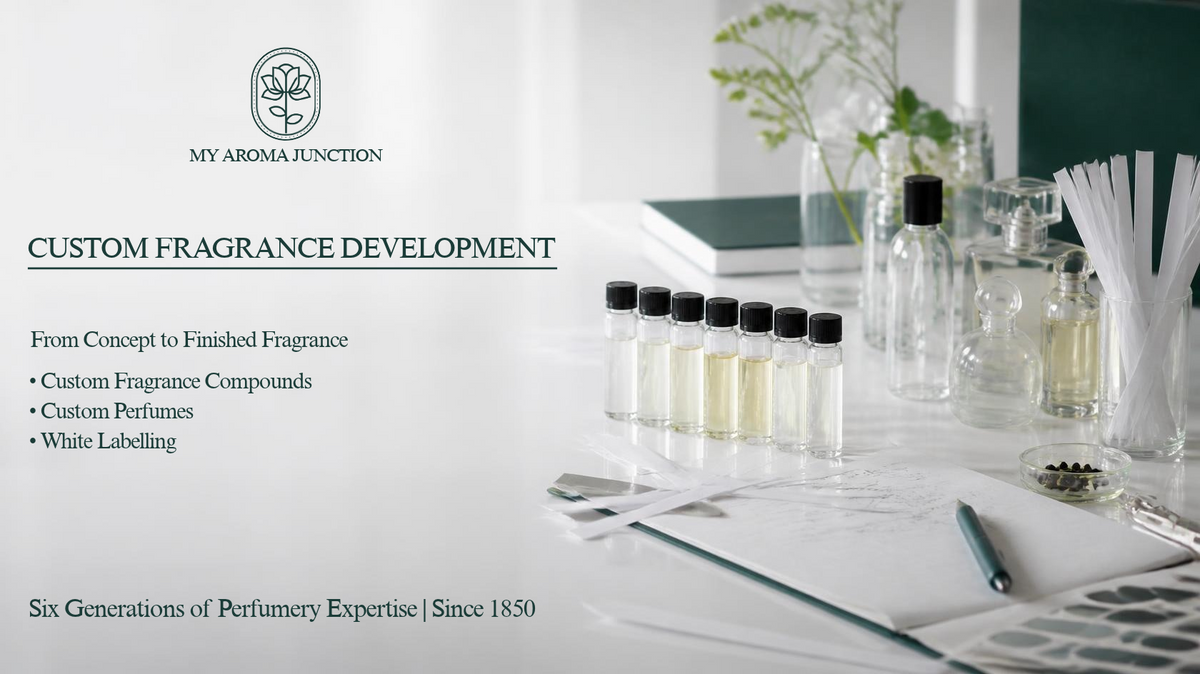
Custom Fragrance Development for Global Brands | From Concept to Finished Fragrance
A fragrance can become the identity of a product.
It can be the scent that makes a new perfume brand recognisable, the signature of a skincare range, the atmosphere of a home fragrance collection or the sensory element that makes a finished product feel complete.
But developing that fragrance requires more than finding a pleasant-smelling perfume oil.
The fragrance needs to work with the intended application, target customer, market, product base and regulatory requirements. For a startup, it also needs to make commercial sense at the beginning of the journey.
That is where custom fragrance development comes in.
From Your Concept to a Finished Fragrance

At MY AROMA JUNCTION, we work with brands, startups, cosmetic manufacturers and businesses looking to develop fragrances for their own products or markets.
A fragrance brief may begin with something very specific - a reference fragrance, a few preferred notes, a target market, a product application or simply an idea of how the finished product should feel.
Our role is to translate that direction into a workable fragrance formulation and take it through development, sampling, evaluation and production.
Your Brief → Our Formulation → Samples → Approval → Production
The process can be developed around the product, application, fragrance direction and target market rather than forcing every project into the same formulation approach.
What We Develop

Fine Fragrance
EDP • Extrait • Attar • Perfume Oils
Develop fragrance profiles for perfume brands, fragrance startups and businesses looking to build a distinctive fine-fragrance collection.
Personal Care
Soap • Shampoo • Body Wash • Lotion
Fragrance development for personal-care applications where the fragrance needs to perform within the intended product base and use conditions.
Home Fragrance
Diffuser • Room Fragrance • Candle • Air Care
Create fragrance directions for home and space applications, considering the intended format, diffusion characteristics and market positioning.
Industrial / Functional
Custom fragrance compounds for specific applications
Develop fragrance compounds where scent is part of the final product experience or is required for a specific industrial or functional application.
Give Us Your Concept. We'll Formulate It.
From fragrance startups to established manufacturers, we develop fragrance solutions around your product and market requirements.
Why Regional Fragrance Knowledge Matters
A fragrance that performs well in one market may not necessarily be the right fragrance direction for another.
Fragrance preferences are influenced by culture, climate, purchasing behaviour, established olfactory traditions, product format and the way consumers use fragrance in their daily lives.
This is particularly important for brands entering international markets. The objective is not simply to create a fragrance that smells good on a blotter. It is to develop a fragrance direction that makes sense for the intended consumer and application.
Fragrance Directions for Middle Eastern Markets

Middle Eastern fragrance markets are diverse, and preferences vary between countries, consumer groups and product categories. However, several olfactory directions have strong cultural and commercial relevance across the Gulf and wider Middle Eastern market.
Rich, warm and long-lasting fragrance profiles are particularly important in many parts of the region. Oud, musk, amber and rose remain important fragrance references, while saffron, spices, woods, incense and sweet oriental facets are also frequently used to build depth and character.
Oud-based compositions can range from traditional, deep and smoky interpretations to cleaner, smoother and more contemporary styles. Musk can provide a softer skin-like dimension, while amber, vanilla, woods and spices can add warmth and richness.
For brands developing fragrances for Middle Eastern consumers, the fragrance direction may therefore explore combinations such as:
- Oud with rose, saffron or amber
- Oud with musk and woods
- Warm amber and vanilla compositions
- Musk-led fragrances with clean or luxurious facets
- Rose and woody compositions
- Spicy, resinous and incense-inspired directions
- Modern interpretations of traditional oriental fragrance profiles
- Fresh or aquatic directions for lighter, contemporary positioning
The important point is that Middle Eastern fragrance development does not have to mean creating an extremely heavy perfume. Modern consumers and younger audiences are also exploring fresher, cleaner and more contemporary interpretations while retaining familiar regional fragrance cues.
Fragrance Directions for European Markets

Europe is not one single fragrance market. Consumer preferences differ between countries, generations, price segments and product categories.
European fragrance consumers increasingly look for distinctive fragrance identities, premium feel, longevity and interesting combinations of notes. This creates opportunities for brands that want to develop fragrances with a clear olfactory identity rather than simply reproducing a conventional profile.
Depending on the target market and positioning, European fragrance development can explore a wide range of directions including:
- Fresh citrus and aromatic compositions
- Floral fragrances with modern interpretations
- Woody and musky compositions
- Clean and contemporary skin-scent directions
- Amber and warm compositions
- Vanilla and modern gourmand interpretations
- Green and natural-inspired olfactory directions
- Distinctive combinations designed around individuality and personal expression
The growing interest in distinctive combinations also creates space for brands to develop fragrances that combine familiar European preferences with ingredients, accords or olfactory ideas inspired by other fragrance cultures.
Developing a Fragrance for an International Market
International fragrance development starts before the first sample is made.
The target country or region, product category, intended use, consumer profile, price positioning and regulatory requirements can all influence the formulation brief.
For example, a fragrance developed for an EDP may require a different approach from one intended for shampoo, body wash, candle, reed diffuser or a functional household application.
That is why we consider the intended application and target market as part of the development brief rather than treating the fragrance concentrate as an isolated product.
Regulatory-Aware Fragrance Development

For brands targeting international markets, fragrance development also needs to consider the regulatory environment of the destination market.
Requirements vary according to the country, product category, intended use and the way the final product is marketed. A fragrance intended for a cosmetic product may have different requirements from one intended for a candle, home fragrance or industrial application.
Our development approach can take the intended market into account from the formulation stage, helping brands and manufacturers work toward the applicable requirements for their target region.
IFRA Standards
The IFRA Standards provide a globally recognised fragrance-industry framework for the safe use of fragrance ingredients. Depending on the intended application, fragrance materials may be prohibited, restricted or subject to specifications.
For fragrance compounds, the intended end use and IFRA category are therefore important considerations during development.
European Union Cosmetics Requirements
For cosmetic products intended for the European Union, development may need to consider Regulation (EC) No. 1223/2009 and its applicable amendments, including requirements concerning restricted or prohibited substances, ingredient information and fragrance allergen labelling.
The EU has also expanded its individually labelled fragrance-allergen requirements through Regulation (EU) 2023/1545. This makes accurate fragrance composition and allergen information increasingly important when developing cosmetic fragrances for the European market.
United Kingdom
For brands targeting Great Britain, cosmetic products are subject to the applicable UK cosmetics framework, including requirements relating to safety assessment, Product Information Files, Responsible Persons, labelling and product notification.
United States
For cosmetic products entering the United States, the applicable FDA requirements and the Modernization of Cosmetics Regulation Act (MoCRA) need to be considered. These include requirements relating to cosmetic safety, facility registration, product listing and other responsibilities depending on the product and business structure.
Middle Eastern Markets
Markets across the Middle East can have their own product registration, conformity, documentation and labelling requirements. For example, Saudi Arabia has cosmetic product notification requirements through the Saudi Food and Drug Authority (SFDA), while the UAE operates conformity requirements for regulated cosmetic products through its conformity-assessment framework.
The exact regulatory pathway depends on the destination country and the finished product. Our role is to develop the fragrance with the intended market and application in mind and provide relevant fragrance-side technical information required for the customer's regulatory, safety or product-development process.
Documentation for Fragrance Development
A fragrance development project is not complete simply because the fragrance smells right. For international business, technical information can be equally important.
Depending on the fragrance, application and destination market, relevant documentation may include:
- IFRA documentation / Certificate of Conformity for the intended use
- Fragrance allergen information
- Safety Data Sheet (SDS)
- Ingredient information required for the customer's regulatory process
- Application-specific information
Fragrance development can support that process by supplying the relevant fragrance information and documentation required for the assessment.
Built for Startups, Not Just Large Manufacturers

Starting a fragrance brand can involve significant uncertainty.
A new business may still be testing its product-market fit, learning which fragrance profiles customers prefer and deciding which markets to enter. Committing to very large quantities before understanding demand can make that process unnecessarily difficult.
That is why our development and supply approach is designed to be accessible to emerging brands as well as established businesses.
Our objective is to offer startup-compatible MOQ options wherever the project and production requirements allow, giving new brands an opportunity to develop, sample and understand their market before scaling production.
As a brand grows, the fragrance can move from development and sampling into repeat production and larger-volume supply.
From Concept to Finished Fragrance
Every project begins with understanding the brief.
01 — Your Brief
Your product, application, target market, fragrance direction, reference, preferred notes and commercial requirements.
02 — Our Formulation
Our perfumery and formulation expertise translates the brief into fragrance concepts suitable for the intended application.
03 — Samples
Samples are developed for evaluation, allowing the fragrance direction to be reviewed and refined.
04 — Application & Evaluation
The fragrance can be evaluated within its intended product or application rather than relying only on a blotter evaluation.
05 — Approval
Once the fragrance direction is approved, the formulation is standardised for production.
06 — Production & Supply
The approved fragrance moves into production, documentation and dispatch according to the agreed requirements.
Your Brief → Our Formulation → Samples → Approval → Production
Six Generations of Perfumery Knowledge Behind Modern Fragrance Development

MY AROMA JUNCTION brings something to fragrance development that cannot be created overnight: generations of accumulated olfactory knowledge.
For over 170 years, six generations of our family have carried forward the art and knowledge of perfumery from Lucknow. What began with traditional attar-making evolved over generations into a broader fragrance practice covering perfumes, attars, home fragrances, incense and industrial fragrance solutions.
Today, that heritage is combined with modern formulation practices and application-based development.
170+ Years • Six Generations • 500+ Developed Fragrances
With 500+ developed fragrances across diverse olfactory families and applications, our fragrance library continues to evolve with customer requirements, market demand and new development briefs.
The result is a balance between traditional fragrance knowledge and contemporary product development.
Give Us Your Concept. We'll Formulate It.
Whether you are developing your first fragrance brand, launching a cosmetic product, creating a home fragrance range or entering an international market, tell us about your concept and requirements.
Your Brief → Our Formulation → Samples → Approval → Production
Start Your Fragrance DevelopmentFrequently Asked Questions About Custom Fragrance Development
What is custom fragrance development?
Custom fragrance development is the process of creating a fragrance formulation around a specific product, application, fragrance direction, target consumer or market. It can include fine fragrance, personal care, home fragrance and industrial or functional applications.
Can you develop a custom perfume for a new fragrance brand?
Yes. Custom perfume development can be undertaken for fragrance startups and established brands, including EDP, extrait, attar and perfume-oil formats, depending on the project requirements.
Do you develop fragrance compounds for cosmetic manufacturers?
Yes. Fragrance compounds can be developed for applications such as soap, shampoo, body wash and lotion, with the formulation brief taking the intended application and target market into consideration.
Can you develop fragrances for international markets?
Yes. Fragrance development can be planned around the intended destination market, product category and applicable requirements. Projects may consider markets such as the European Union, United Kingdom, United States, Middle East and other international destinations.
Can you develop an IFRA-compliant fragrance?
Fragrance formulations can be developed with the applicable IFRA Standards and intended application category in consideration. Relevant IFRA documentation can be provided as applicable to the fragrance and intended use.
Can you provide fragrance allergen information and technical documents?
Relevant fragrance-side documentation can be provided depending on the formulation, application and project requirements. This may include IFRA documentation, allergen information, SDS, TDS, COA and other technical information where applicable.
Do you work with fragrance startups?
Yes. Our development and supply approach is designed to support both emerging brands and established businesses, with startup-compatible MOQ options considered where the project and production requirements allow.
What is the process for developing a custom fragrance?
The development process follows a structured path: your brief, formulation, samples, evaluation, approval, production and supply. The exact development process depends on the application and project requirements.
What information should I provide for a fragrance development enquiry?
A useful brief can include the product type, application, target market or country, preferred fragrance direction, reference fragrance if available, preferred notes, target positioning, expected quantity and any known regulatory or documentation requirements.


Leave a comment
This site is protected by hCaptcha and the hCaptcha Privacy Policy and Terms of Service apply.